
EV Charging in Cold Weather: Home Charging Tips for Bozeman
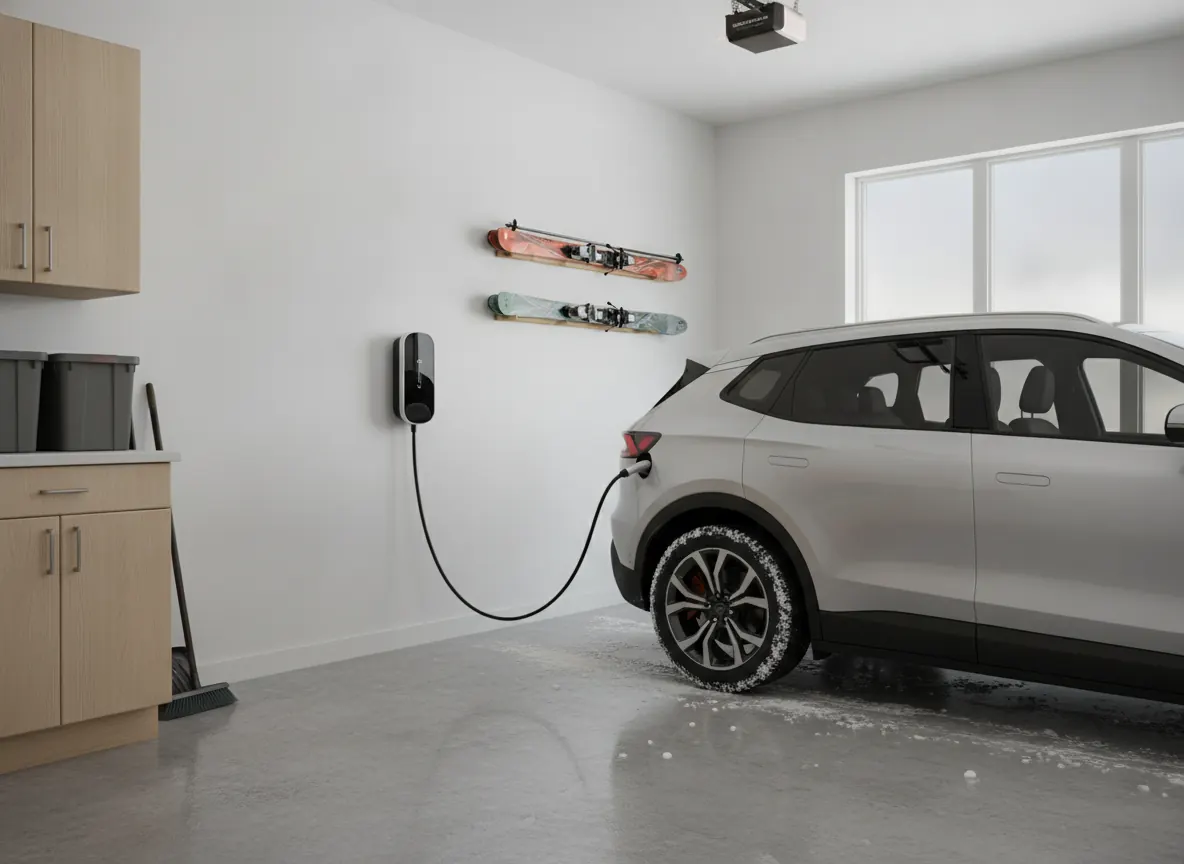
Short answer: an EV can charge at home through a Bozeman winter, but cold slows charging and eats range, so the setup matters more here than in a mild climate. Most owners do best with a Level 2 charger on a properly sized 240 V circuit, mounted where the cable reaches without dragging through snowmelt, and with charging scheduled so the car warms its battery while still plugged in.
This guide covers what cold does to charging, preconditioning, where to put the charger in a garage, and how to size the circuit for a house that already runs heat all winter in Bozeman, MT. It is general information. Your vehicle and charger manuals come first.
How cold affects EV charging in Bozeman
Bozeman's cold is long rather than rare. The Montana State University weather station averages 7,828 heating degree days a year and about 13.5 nights at or below 0°F; the airport station near Belgrade averages about 24 (NOAA 1991–2020 normals). On January 13, 2024, MSU recorded -40°F and the airport -45°F.
In general, lithium-ion batteries accept charge more slowly when they are cold, and many vehicles spend energy warming the battery before they charge at full speed. Cabin heat also draws from the battery while you drive. The result owners notice: fewer miles per charge in January and longer sessions to fill up. How much depends on the vehicle, so check the owner's manual and the car's app.
Preconditioning: warm the car while it is plugged in
Most EVs let you set a departure time or start climate control from an app. When the car is plugged in, much of that warm-up energy can come from the wall instead of the battery. General guidance that applies to many vehicles:
- Plug in every night in deep cold, even if the battery isn't low. Many cars use shore power to keep the battery in a healthy temperature range.
- Set a scheduled departure so charging and cabin warm-up finish shortly before you leave.
- If your car offers battery preconditioning before fast charging on a trip, use it as the manufacturer describes.
- Expect the car to draw power for a while after the battery reads full on very cold nights; that is often battery heating.
Preconditioning works best with a Level 2 charger, because a 120 V outlet may supply little more than the car uses to stay warm.
Level 1 or Level 2 for a Montana winter?
Level 1 charging uses a standard 120 V outlet. It can work for short daily drives in mild weather. In a Bozeman cold snap, part of that slow trickle can go to battery and cabin heating, so you may gain few miles overnight. Level 2 runs on 240 V, the kind of circuit a dryer or range uses, and adds range several times faster. For most households that drive daily through the winter, Level 2 is the practical choice.
If you do rely on Level 1 for now, have a licensed electrician check that the outlet is on a circuit that isn't shared with a garage heater, freezer or block heater, and that the outlet and wiring are in good condition. Long charging sessions are a steady load that older outlets don't always handle well.
Where to put the charger in your garage
Placement is where winter shows up most. A few points to raise with each contractor:
- Cable reach. Mount the charger so the cable reaches the charge port with slack, without crossing the floor where snow and slush melt off the car. Cold cables stiffen, so a holster or hook helps.
- Distance to the panel. The farther the charger is from the panel, the more wire and labor. Asking for the charger on the panel side of the garage can save money.
- Detached garages. A detached garage may need a feeder and a subpanel, sometimes with a trench. Ask whether the existing feeder can carry the charger.
- Outdoor mounting. If the car parks outside, ask for a charger and enclosure rated for outdoor use and the cold, and where the cable will rest when snow piles up.
- Heated garages. A garage heater is already a large load. The load calculation should count it.
Circuit sizing for an EV charger
Home Level 2 chargers usually sit on a 40, 50 or 60 amp circuit. EV charging counts as a continuous load, so the circuit is generally sized at 125% of the charger's draw. A charger set to 32 amps needs a 40 amp circuit; one set to 48 amps needs a 60 amp circuit. Many chargers can be set lower, which helps when the panel is tight.
Winter is when your house uses the most power. About 35.9% of occupied homes in Bozeman heat mainly with electricity (ACS 2020–24 5-year), and many others add heat pumps with backup strips, baseboard in a bonus room, roof heat cable or a block heater. A licensed electrician should do a load calculation that includes those loads. If the numbers are tight, the usual options are a lower charger setting, a load-management device that pauses charging when the house is busy, or a panel upgrade.
NorthWestern Energy's construction services page asks customers adding an EV charger to use its Construction Application. If a service upgrade is involved, ask whether any NorthWestern charge is in the quote or billed separately.
What it costs, and the permit
| Job | Typical range | Source |
|---|---|---|
| Level 2 EV charger install | $555–$1,380 (avg ≈ $967) · $1,200–$3,000 | Angi · HomeGuide |
| Panel upgrade, 100 to 200 A | $1,300–$4,500 | HomeGuide · Fixr |
| Montana state electrical permit, one added circuit (outside Bozeman, Belgrade, Manhattan) | $45 | Montana DLI form, Rev. 11/25 |
Inside Bozeman, Belgrade and Manhattan, the city sets the permit fee; ask the contractor or the city building division. The Bozeman electrician cost guide has a planning calculator, and the EV charger installation page covers hiring.
Before you sign: ask for a written, itemized quote listing the charger, breaker, wire size, conduit, labor, permit and inspection. Ask whether a load calculation was done, who pulls the permit, and whether there is a trip or diagnostic fee. Don't pay the full amount upfront.
Montana requires electricians and electrical contractors to be licensed by the State Electrical Board (MCA Title 37, ch. 68). Look up any contractor or electrician by name or license number in the Montana DLI license lookup, and ask to see the license; electricians must carry it on the job. Ask for a certificate of liability insurance. The State Electrical Board requires contractors to carry workers' compensation and unemployment insurance coverage (or hold an exemption); it does not set a liability insurance amount.
If you are also planning electric heat, read heat pumps and your electrical panel first, so one load calculation covers both.
About this site: Bozeman Electricians is a free quote-referral service, not an electrician or electrical contractor. It holds no Montana electrical license and does not perform electrical work. You describe the job once, and independent electrical contractors licensed by the Montana State Electrical Board and serving Bozeman, MT and the Gallatin Valley can reply with quotes on their own schedules. Some contractors may pay to receive requests or calls. Request free quotes.
Frequently asked questions
Do EVs charge slower in cold weather?
Generally, yes. Cold batteries accept charge more slowly, and many cars use energy to warm the battery before charging at full speed. Plugging in every night and scheduling departure so the car preconditions while connected helps. Check your owner's manual for your model.
Is Level 1 charging enough in a Bozeman winter?
For short drives it can be, but in deep cold part of a 120 V outlet's output may go to keeping the battery and cabin warm. Most daily winter drivers find a Level 2 charger on a 240 V circuit more practical.
What size circuit does a home EV charger need?
Usually 40, 50 or 60 amps. Charging is a continuous load, so a 32 amp charger needs a 40 amp circuit and a 48 amp charger needs a 60 amp circuit. A licensed electrician should size it after a load calculation that includes your winter heating loads.
Can an EV charger be installed outside in Montana?
Many chargers are rated for outdoor use. Ask the contractor for a unit and enclosure rated for the location and cold, a mounting spot clear of snow piles, and how the cable will be stored. A permit applies either way.